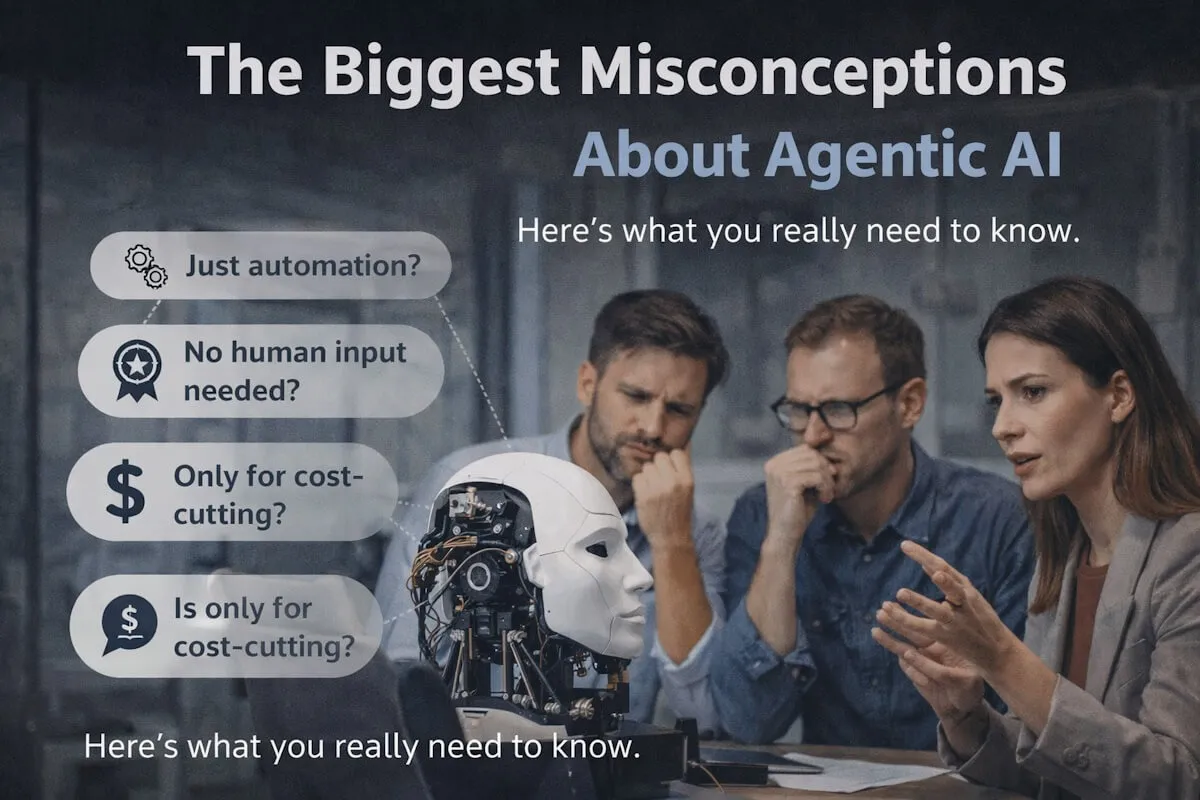
Agentic AI is getting a lot of attention right now.
Some people see it as the next big shift in how businesses operate. Others see it as overhyped or risky. And in between, there’s a lot of confusion.
That confusion usually comes from misconceptions.
When something new shows up, people fill the gaps with assumptions. Some of those assumptions stick. Even when they’re not accurate.
If you’re planning to explore this space, it’s worth clearing these up first.
Let’s walk through the biggest misconceptions and what’s actually going on.
Misconception 1: It’s just another version of automation
This is the most common one.
People assume agentic AI is just advanced automation. A better version of workflows they already use.
Not quite.
Traditional automation follows fixed steps:
- If this happens, do that
Agentic systems work differently.
They:
- Operate based on goals
- Decide the next step
- Adjust actions based on outcomes
That shift changes how work gets done.
You’re not just automating tasks. You’re enabling systems to act toward an outcome.
Misconception 2: It removes the need for human involvement
This one creates unnecessary fear.
The idea that agentic AI replaces people completely is misleading.
What it actually does is reduce repetitive execution.
Humans are still needed for:
- Strategy
- Complex decision-making
- Oversight
- Handling sensitive situations
Think of it as shifting focus, not removing roles.
Your team spends less time on routine tasks and more time on meaningful work.
Misconception 3: It works perfectly from day one
Some expect instant results.
Set it up once and everything runs smoothly.
That’s not how it works.
Agentic systems need:
- Clear goals
- Well-designed workflows
- Testing in real scenarios
- Ongoing adjustments
The first version is just the starting point.
Performance improves over time as the system learns and gets refined.
Misconception 4: It’s only useful for large enterprises
This belief keeps smaller businesses from even trying.
Agentic AI is not limited to big companies.
In fact, smaller teams often benefit more.
Why?
Because they:
- Have limited resources
- Need to move quickly
- Can’t afford delays
Agentic systems help them handle more work without increasing team size.
That’s a big advantage.
Misconception 5: It’s too complex to implement
Yes, it involves multiple components.
But that doesn’t mean it’s out of reach.
The key is to start small.
You don’t need to automate your entire business.
Begin with:
- One workflow
- One problem
- One clear outcome
Build from there.
Many businesses work with Agentic AI Development Services to simplify this process and avoid unnecessary complexity.
Misconception 6: More autonomy means less control
This one sounds logical, but it’s not accurate.
People worry that if systems act independently, they’ll lose control.
In reality, well-designed agentic systems include:
- Clear rules
- Defined boundaries
- Escalation paths
- Visibility into actions
You decide what the system can and cannot do.
Control doesn’t disappear. It becomes structured.
Misconception 7: It replaces all existing tools
Some think adopting agentic AI means starting from scratch.
That’s not the case.
Agentic systems usually work with your existing tools.
They connect with:
- CRMs
- Support platforms
- Internal systems
They don’t replace everything. They coordinate and execute across what you already use.
Misconception 8: It’s only about cost-cutting
Cost reduction is one benefit.
But focusing only on that misses the bigger picture.
Agentic AI also improves:
- Speed of execution
- Consistency
- Capacity to handle more work
- Customer experience
It’s not just about saving money.
It’s about improving how your business runs.
Misconception 9: You need a full team to get started
Some assume they need a large internal team to build and manage these systems.
That’s not always necessary.
You can start by working with external experts or by bringing in a small focused team.
When you Hire AI Agent Developers, you gain access to experience without building everything from scratch internally.
This makes it easier to get started.
Misconception 10: It’s a one-time setup
This is a big one.
Some treat agentic AI like a tool you install and forget.
It doesn’t work that way.
Agentic systems need:
- Monitoring
- Updates
- Refinement
They improve over time.
Treating them as static systems limits their value.
Why these misconceptions matter
Misconceptions don’t just create confusion.
They slow decisions.
They lead to:
- Delayed adoption
- Poor implementation choices
- Unrealistic expectations
Clearing them up helps you approach this space with the right mindset.
What you should actually focus on
Instead of worrying about what agentic AI might be, focus on what it can do for your business.
Ask:
- Where do we lose time in execution?
- Which processes feel repetitive?
- Where do delays happen often?
These questions lead you to real opportunities.
A more grounded way to think about it
Agentic AI is not magic.
It’s not perfect.
It’s not a replacement for people.
It’s a way to improve how work gets done.
That’s it.
When you look at it from that angle, it becomes easier to evaluate and adopt.
The bigger shift behind the hype
Behind all the noise, there’s a simple shift happening.
From manual execution to goal-driven systems.
From constant supervision to structured autonomy.
From task management to outcome-focused workflows.
That’s what matters.
So, what should you take away from this?
Don’t let misconceptions shape your decisions.
Take a closer look. Ask better questions. Start small.
You don’t need to get everything right on day one.
You just need to get started with the right understanding.
Because once you see how these systems work in practice, the confusion fades.
And what’s left is a clearer path forward.